
Hospitality AI
The True Cost of a Missed Spa Call (Spoiler: It's More Than One Massage)

Spa coordinators are trained to think about a missed call as a missed booking, but it dramatically undercounts the actual revenue at stake. The honest accounting of a missed spa call has at least four lines, and three of them never make it into the conversation.
Line 1: the missed treatment
This is the obvious line: a 60-minute massage at a typical day spa costs $145, at a resort spa: $220-$280, and at a luxury urban spa: north of $300. Add the standard 18-22% gratuity and you are at $175 to $370 of immediate revenue per call. This is the number every operator sees.
Line 2: the retail attach
The data here is striking, and almost universally underused. When a guest books in person, and to a lesser but still real extent on the phone, she is meaningfully more likely to add retail, such as body oils, scrubs, the takeaway products her therapist recommends. Industry attach rates run 12-18% of treatment revenue at well-run spas. A missed call is not just a missed massage, it is also $25 to $60 of retail that was never going to happen because the conversation never happened.
Line 3: the gift card and package upsell
Some meaningful share of inbound spa calls are not bookings, they are gift card or package inquiries. These are higher-margin transactions and they convert at remarkable rates when there is a knowledgeable human (or AI) on the phone. For example, "I want to send my mother something for Mother's Day" is a $200+ transaction nine times out of ten. Voicemail kills it.
Line 4: the lifetime value of a found therapist
This is the line operators consistently miss: when a spa guest finds a therapist she likes, she does not come once, she comes monthly, or every six weeks, or every time she travels to your city. She brings her friends, she buys gift cards for her sister. The lifetime value of a single "found" guest is several thousand dollars over a typical 3-to-5-year relationship, and the entire relationship begins with one phone call that she may or may not get to make.
When we model this for spa clients, we use a conservative $1,500 LTV adjustment per booked first-time guest. For luxury and resort spas, the number is meaningfully higher. The implication is that every first-time call you miss is not a $200 loss, it is a $1,700 loss, of which $1,500 is the relationship that never started.
What this means for staffing decisions
Most spa coordinators are doing the math with line 1 only. When they advocate for more phone coverage, they are pitching their GM on "recovering $175 a call." The GM looks at the labor cost and the math doesn't quite work. If the same coordinator pitched on "recovering $1,700 of LTV-adjusted value per first-time miss," the conversation would be very different.
And this is exactly why AI voice answering has become the right answer for spas faster than for almost any other vertical: the marginal cost is low enough that you don't have to argue with the LTV math, you just stop missing calls. The bookings, the retail, the gift cards, and the LTV all start showing up. Most spa clients see the first signal within two weeks and the full signal within 60 days.
The honest punchline
We spend a lot of time talking to spa directors about their missed-call problem. The hardest part of the conversation is almost always the same moment: when the director sees the LTV math for the first time and realizes how badly her property has been undervaluing each unanswered call. Once that lands, the rest of the decision is almost mechanical.
If you want us to run the same math for your spa, send us a representative two weeks of call logs and we will model it specifically, no charge, no obligation, hospitality-vet to hospitality-vet.
Continue Reading
A New Chapter for LOULOU AI: Building Tech That Elevates Human Connection
LOULOU AI is proud to announce its first institutional funding, a startup grant from the South Carolina Research Authority. This milestone accelerates our mission to build technology that supports hospitality teams, elevates the guest experience, and captures opportunities without compromising human connection. In this article, we'll explore the significance of this funding and how it reflects our commitment to innovation in hospitality technology.
April 14, 2026 · 3 min
Hospitality AI
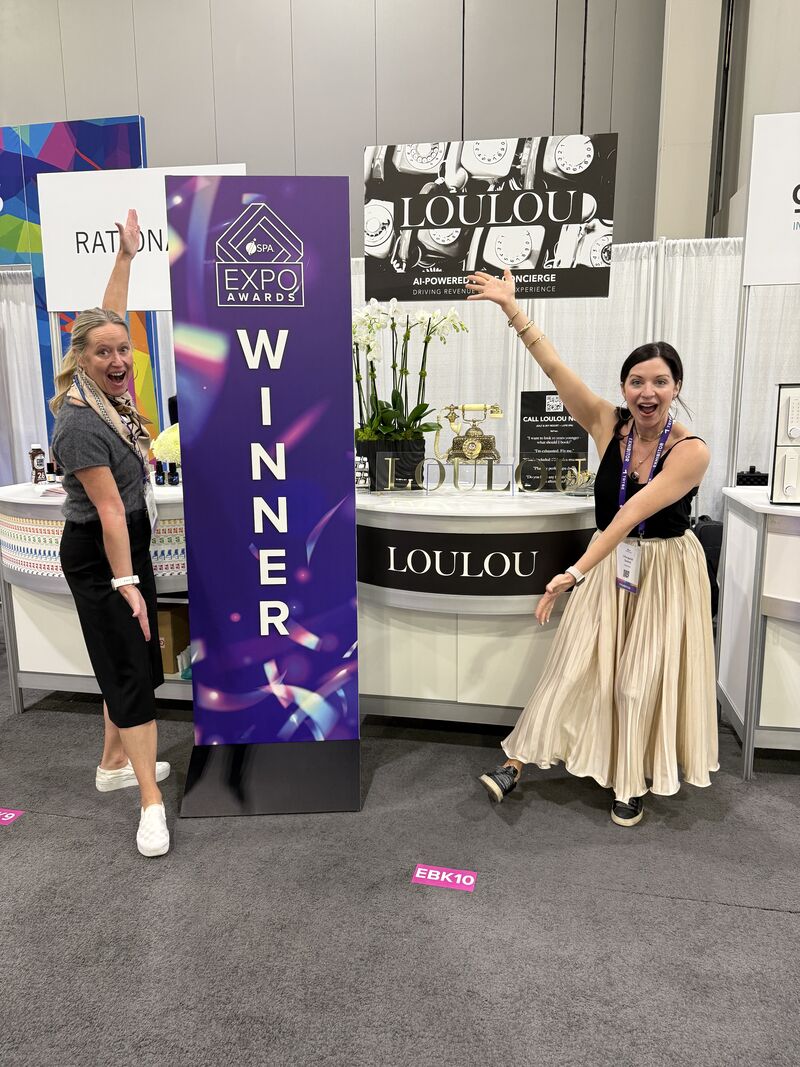
LOULOU Named Best New Product at ISPA 2026, What It Means for Hospitality AI
We went into ISPA with no expectations. We left with the Best New Product/Service award, and with something more important: confirmation that the problem we built for is exactly the problem operators are living every day.
April 13, 2026 · 6 min
The Math of Hospitality: Why Working Smarter Matters
The hospitality industry faces immense pressure due to labor shortages and rising costs. To stay afloat, it's crucial to work smarter and protect both guest experience and revenue. Learn how to overcome these challenges with the right strategies and technologies.
April 11, 2026 · 3 min